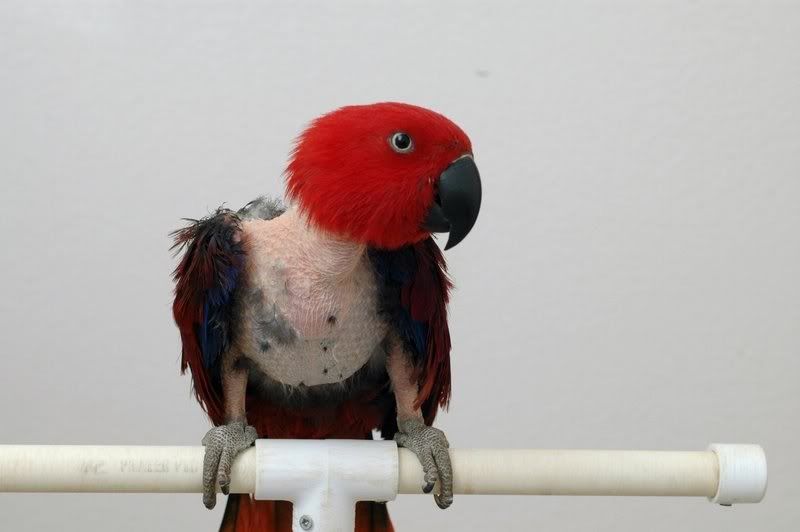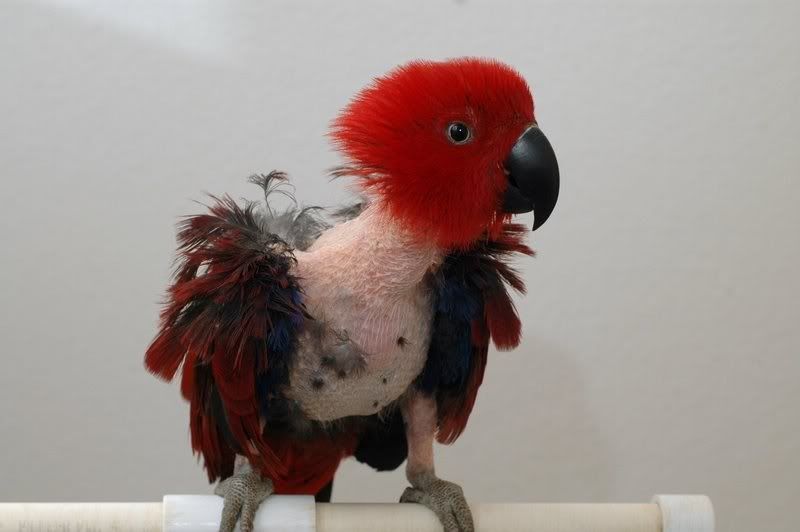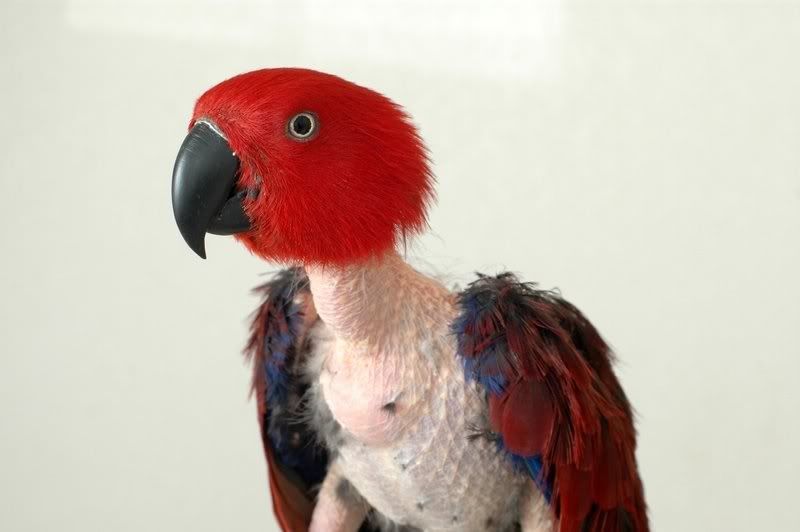
Lexy is not currently up for adoption, as we need to find out the results of her thyroid testing and work to transform her diet. However, she will be looking for a new home once her health improves.
Wednesday, May 28, 2008
Lexy the Eclectus
Lexy is not currently up for adoption, as we need to find out the results of her thyroid testing and work to transform her diet. However, she will be looking for a new home once her health improves.
Wednesday, April 16, 2008
More information on proposed Wisconsin quaker ban
We wanted to update our readers with information that has been communicated to several of our volunteers from the DNR in response to e-mails that were sent.
Directly quoted from the e-mail (another e-mail was also received; however, the wording seemed less confusing in this one):
"The DNR is not seeking to restrict (ban) pet ownership or sales of monk parrots, and I think you are misinformed or misunderstand the rule's language. I am not sure where you obtained your information, but you might want to read the draft rule for yourself in the attachment, if you have not done so. Pages 16-17 specifically address monk parrot status. We will be improving the draft language to make it more clear that possession and sale of them is legal. Under the staff's DRAFT rules, monk parrots will be classified as a prohibited terrestrial and aquatic vertebrate invasive species along with Russian boar, feral swine and mute swan. The draft rules state that no person may transport, possess, transfer or introduce a prohibited invasive species such as a monk parrot unless one or more of the following applies:
- the monk parrot is a legally obtained nonnative wild animal that is a pet, in which case it may be possessed, transported or transferred, but not introduced, without a permit under these rules. (Notice it is stated that animals must be legally obtained. Apparently there are many cage birds in the pet trade that are not obtained legally within the country of origin, smuggled, etc.)
- the department determines that the transportation, possession, transfer or introduction was incidental or unknowing, and was not due to the person’s failure to take reasonable precautions.
- the person has a department permit issued under the rules to transport, possess, transfer or introduce the bird for research, education, identification, control or disposal or for other purposes specified by the department in the permit.
Introducing them, or any nonnative wild animal, to the wild is currently and will continue to be illegal, and this is the critical issue. Should monk parrots become established anywhere in the state and for whatever reason, their prohibited status in the draft rule would allow for their control in the wild if necessary. Based upon the experiences of other states and countries, it seems highly probable that, should monk parrots become established in the wild in WI, there will be a variety of problems associated with them. We want to avoid that situation.
We are not trying to slip anything past the public. Six public listening session were held around the state in January, 2008 to obtain initial public response. After numerous modifications, we are now seeking Natural Resources Board approval to hold formal public hearings sometime this summer. We anticipate further modification of the rule, based upon comments from the public hearings, before seeking NRB approval. As mentioned above, it is clear that we will improve the language pertaining to monk parrot possession and transfer."

If the draft passes and becomes the actual law, it appears as though legally-obtained pet quakers will still be legal. The state is just trying to proactively find a solution in case quakers establish feral colonies here, like they have in Chicago, Barcelona, and many other cities.
However, as listening sessions are scheduled to be held over the summer, there is always the possibility that the final version may not exactly mirror the draft version. We will keep you updated as to any developments in this manner.
Thanks to those of you who contacted your representatives to let them know your views, and thanks to the DNR for providing a civil and polite response to those inquiries!
Photos: The top photo is of Missy, a quaker that spent many months here before recently finding her new home. The bottom photo is of Sam, who loves hanging out in her little house!
Directly quoted from the e-mail (another e-mail was also received; however, the wording seemed less confusing in this one):
"The DNR is not seeking to restrict (ban) pet ownership or sales of monk parrots, and I think you are misinformed or misunderstand the rule's language. I am not sure where you obtained your information, but you might want to read the draft rule for yourself in the attachment, if you have not done so. Pages 16-17 specifically address monk parrot status. We will be improving the draft language to make it more clear that possession and sale of them is legal. Under the staff's DRAFT rules, monk parrots will be classified as a prohibited terrestrial and aquatic vertebrate invasive species along with Russian boar, feral swine and mute swan. The draft rules state that no person may transport, possess, transfer or introduce a prohibited invasive species such as a monk parrot unless one or more of the following applies:
- the monk parrot is a legally obtained nonnative wild animal that is a pet, in which case it may be possessed, transported or transferred, but not introduced, without a permit under these rules. (Notice it is stated that animals must be legally obtained. Apparently there are many cage birds in the pet trade that are not obtained legally within the country of origin, smuggled, etc.)
- the department determines that the transportation, possession, transfer or introduction was incidental or unknowing, and was not due to the person’s failure to take reasonable precautions.
- the person has a department permit issued under the rules to transport, possess, transfer or introduce the bird for research, education, identification, control or disposal or for other purposes specified by the department in the permit.
Introducing them, or any nonnative wild animal, to the wild is currently and will continue to be illegal, and this is the critical issue. Should monk parrots become established anywhere in the state and for whatever reason, their prohibited status in the draft rule would allow for their control in the wild if necessary. Based upon the experiences of other states and countries, it seems highly probable that, should monk parrots become established in the wild in WI, there will be a variety of problems associated with them. We want to avoid that situation.
We are not trying to slip anything past the public. Six public listening session were held around the state in January, 2008 to obtain initial public response. After numerous modifications, we are now seeking Natural Resources Board approval to hold formal public hearings sometime this summer. We anticipate further modification of the rule, based upon comments from the public hearings, before seeking NRB approval. As mentioned above, it is clear that we will improve the language pertaining to monk parrot possession and transfer."
If the draft passes and becomes the actual law, it appears as though legally-obtained pet quakers will still be legal. The state is just trying to proactively find a solution in case quakers establish feral colonies here, like they have in Chicago, Barcelona, and many other cities.
However, as listening sessions are scheduled to be held over the summer, there is always the possibility that the final version may not exactly mirror the draft version. We will keep you updated as to any developments in this manner.
Thanks to those of you who contacted your representatives to let them know your views, and thanks to the DNR for providing a civil and polite response to those inquiries!
Photos: The top photo is of Missy, a quaker that spent many months here before recently finding her new home. The bottom photo is of Sam, who loves hanging out in her little house!
Wednesday, April 09, 2008
Wisconsin considering quaker ban
Please contact your representatives and voice your concern over this matter.
Thursday, April 03, 2008
Saving cockatiel lives
Lemon, a lutino cockatiel, was in worse shape than her cagemate. (We do not have a picture of these birds available yet, but the above picture is of a healthy lutino cockatiel that was surrendered to us last year).
She required extensive care from us. Lemon needed to be gavaged several times a day -- a task made more difficult by the fact that she could barely open her mouth. We had to clean out her eyes and nares three times a day in order to get the mucus out. She had to be given two antibiotics and one pain medication. Additionally, we did physical therapy three times per day to make sure her beak wouldn't clamp shut.
Her cagemate showed fewer signs -- basically just the sniffles. He was treated and, after receiving a clean bill of health, adopted into his new home.
Lemon just went for her three week vet check and is doing great. Her liver levels are a little high yet, so we're treating her with a different antibiotic for two more weeks, then will test her again. Hopefully, at that time she will be released to go to her new home.
Most people wouldn't even try to save a lockjaw bird the prognosis is so poor. But we believe in giving every bird that comes to us a fighting chance.
Monday, March 31, 2008
Buddy, B&G macaw
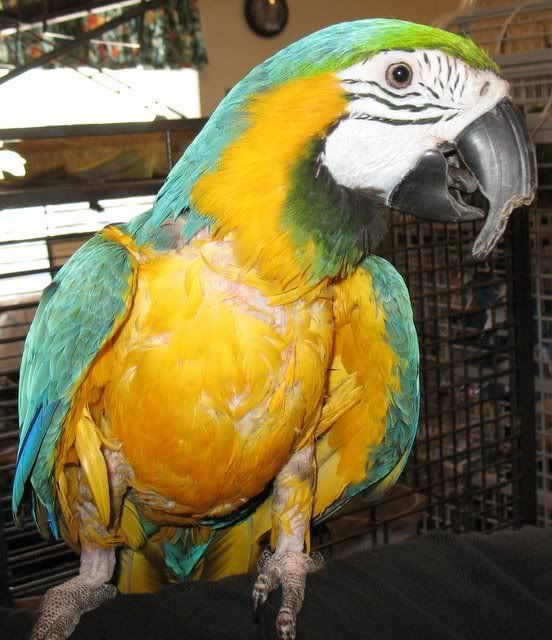
As you can see from the picture, Buddy is slightly plucked. He also is missing part of his beak due to a fungal infection that he survived a couple of years ago. He is no longer sick, and his beak has started to grow back, although we don't know whether his beak will ever get to a point considered "normal."
Buddy was surrendered for noise reasons. Parrots are wild animals and in the wild, Buddy would have had to use his voice to communicate with macaws acres away. As far as we can tell, his vocalizations were normal macaw sounds, and nothing excessive.
We are looking for an understanding and patient home for Buddy. He may need additional vet care due to his beak (for example, trimmings).
If you'd like to adopt this guy, stop by to meet him and fill out our Bird Wanted Questionnaire!
Tuesday, March 25, 2008
Cockatiels, cont.
Wednesday, March 12, 2008
Cockatiels
Unfortunately, this is often not the case, as new animals often don't know where and how to get food. And the Domes is careful to have only one sex of each type of parrot so that there is no breeding. Introduced individuals that figure out how to survive upset this balance, and then breeding happens, bringing more unwanted parrots into this world.
These cockatiels that will be released to us tomorrow look healthy and have been eating a pellet diet. They have not had much human interaction, so they are not tame. However, with some patience (and possible millet treats!) they can make great companions.
We're not sure if you've heard the news, but cockatiels can make great pets! They are very loving, can learn to whistle intricate songs, and perform fun tricks. They love interaction with their favorite humans! Additionally, their voices, although loud at times, are easier on the ears than larger parrots.If you'd like to adopt one of the Domes cockatiels, please fill out a Bird Wanted Questionnaire. There is an adoption fee of $20. All of our normal adoption policies apply.
Subscribe to:
Posts (Atom)