Thursday, April 03, 2008

Saving cockatiel lives

CARE recently had two cockatiels transferred to us from a local humane society. Obviously sick, we rushed them to the vet, and they were diagnosed with lockjaw, which comes from the parents. It also has a very poor prognosis.

Lemon, a lutino cockatiel, was in worse shape than her cagemate. (We do not have a picture of these birds available yet, but the above picture is of a healthy lutino cockatiel that was surrendered to us last year).

She required extensive care from us. Lemon needed to be gavaged several times a day -- a task made more difficult by the fact that she could barely open her mouth. We had to clean out her eyes and nares three times a day in order to get the mucus out. She had to be given two antibiotics and one pain medication. Additionally, we did physical therapy three times per day to make sure her beak wouldn't clamp shut.

Her cagemate showed fewer signs -- basically just the sniffles. He was treated and, after receiving a clean bill of health, adopted into his new home.

Lemon just went for her three week vet check and is doing great. Her liver levels are a little high yet, so we're treating her with a different antibiotic for two more weeks, then will test her again. Hopefully, at that time she will be released to go to her new home.

Most people wouldn't even try to save a lockjaw bird the prognosis is so poor. But we believe in giving every bird that comes to us a fighting chance.

Monday, March 31, 2008

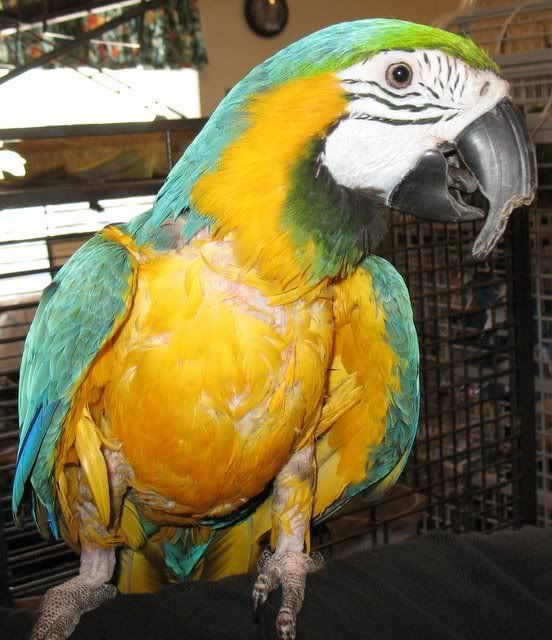
Buddy, B&G macaw

Buddy is a blue and gold macaw that was recently surrendered to CARE. He's still settling in at the Center and we are starting to see his true personality -- which is fantastic, so far!

As you can see from the picture, Buddy is slightly plucked. He also is missing part of his beak due to a fungal infection that he survived a couple of years ago. He is no longer sick, and his beak has started to grow back, although we don't know whether his beak will ever get to a point considered "normal."

Buddy was surrendered for noise reasons. Parrots are wild animals and in the wild, Buddy would have had to use his voice to communicate with macaws acres away. As far as we can tell, his vocalizations were normal macaw sounds, and nothing excessive.

We are looking for an understanding and patient home for Buddy. He may need additional vet care due to his beak (for example, trimmings).

If you'd like to adopt this guy, stop by to meet him and fill out our Bird Wanted Questionnaire!

Tuesday, March 25, 2008

Cockatiels, cont.

Here are some of the cockatiels from the Domes. We still have plenty looking for good homes, so now would be a great time to add one (or a same-sex pair) to your house!

Wednesday, March 12, 2008

Cockatiels

Tomorrow, March 13, CARE will be receiving about 20 cockatiels in from the Domes. As we've mentioned before on the blog, the Domes keeps some small parrots in one of its exhibits. People sneak their birds and reptiles in and release them, thinking they are providing a good life for them.

Unfortunately, this is often not the case, as new animals often don't know where and how to get food. And the Domes is careful to have only one sex of each type of parrot so that there is no breeding. Introduced individuals that figure out how to survive upset this balance, and then breeding happens, bringing more unwanted parrots into this world.

These cockatiels that will be released to us tomorrow look healthy and have been eating a pellet diet. They have not had much human interaction, so they are not tame. However, with some patience (and possible millet treats!) they can make great companions.

We're not sure if you've heard the news, but cockatiels can make great pets! They are very loving, can learn to whistle intricate songs, and perform fun tricks. They love interaction with their favorite humans! Additionally, their voices, although loud at times, are easier on the ears than larger parrots.
If you'd like to adopt one of the Domes cockatiels, please fill out a Bird Wanted Questionnaire. There is an adoption fee of $20. All of our normal adoption policies apply.

Wednesday, February 27, 2008

More budgies!!!

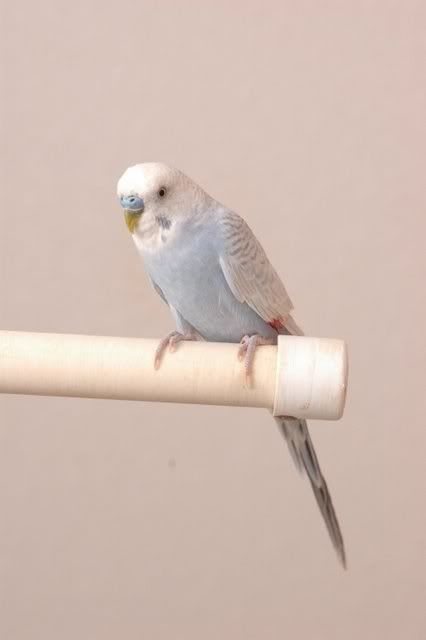
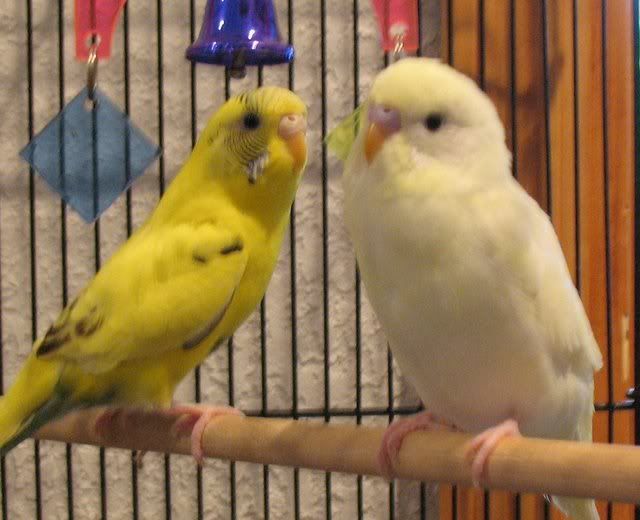
We currently have scores of budgies looking for new homes. Most of these are currently non-tame cage pets; however, with some work, they could become delightful companions. Or, with a buddy and large cage set-up, they can provide happy chirps to any house!

We've had several surrenders of large budgie flocks. This usually starts with a pair of budgies and uncontrolled breeding.

As we've mentioned so many times, budgies are truly underappreciated in the avian community. They are delightful little companions with wonderful personalities. Compared to larger parrots, they are relatively easy-care.
If you're interested in adding a budgie or two (same sex, of course) to your house, please stop by. We have many to choose from! Once you live with one of these little jewels, it's hard to imagine being without one. Their zest for life can brighten any day!

Thursday, February 07, 2008

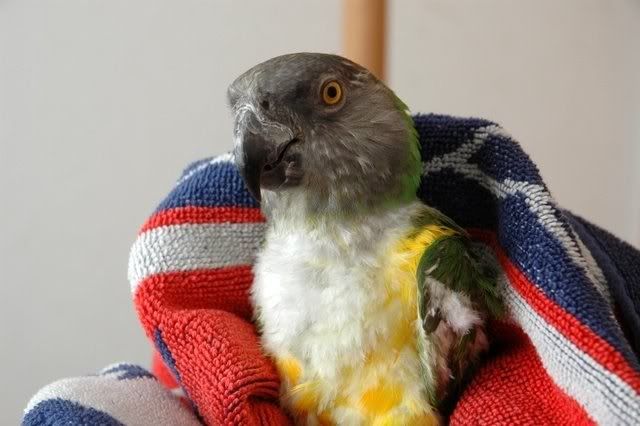
Niko is a wild-caught senegal that was released to our Center last weekend. We know that he is at least 17 years old. His owners in his previous home were chain smokers, which we suspect played a role in his feather destructive behaviors. He was kept in a budgie-sized cage and never let out or handled.
When he came to us, we gave him a bath, as it had been years since he'd had one and we wanted to get rid of his smoky smell. After a drenching bath, we towel-dried him, only to realize that both he and the towel STILL smelled of smoke. Taking a cue from wildlife rehabilitation, we gave him a bath in Dawn to help remove the residue. It worked! After his bath in Dawn, we thoroughly rinsed him with plain water and towel-dried him with a new towel. The smoke smell was mostly gone.

In this video, he is stomping around in the bubbles. Note that plain water is usually best for bathing parrots. In this case, extra ammunition was needed, and he was closely supervised for the duration of his bath.

Niko is not currently up for adoption, as he still has some rehabilitation to do. He had a full vet workup earlier in the week, and we await some test results; however, he seemed healthy upon examination. He currently has some balance issues as he has destroyed most of his wing and tail feathers. We hope that his feathering will improve on a better diet and removal from his smoke-filled environment.

Second-hand cigarette smoke is very detrimental to parrots. The adage of "canary in a coal mine" in apt. They have very sensitive respiratory systems. In addition, since most parrots use their feet to bring food to their beaks, if they are perched on a smoker's hand, they are likely to ingest nicotine or any of the other carcinogens that are present.

Niko's life was likely shortened by his time spent in the presence of so much smoke. Once his health has improved, we are looking for a wonderful home for him that will allow him to live out the rest of his days in smoke-free happiness.

Monday, February 04, 2008

Friends

Millie is completely recovered from his surgery last month. Here he is, along with his friend Cleo, hanging out in a box that was provided to them that morning. Neither one of these birds desires physical human interaction, so it's great that they've found each other. They are both males, so we're not worried about nesting at all by giving them this box. Some parrots can't handle having boxes -- it gets them too hormonal. We don't have to worry about that with them; although, if any problems surfaced, we would remove the box.